Table of Contents
Spending more does not always mean getting more. Everyone knows that. But with tooth implants, the opposite is often true. The cheap option is not just cheaper. It is worse. Worse materials. Worse planning. Worse long-term outcomes. And when that cheap implant fails, you are back to square one. Only now you have spent more than you would have if you had chosen quality from the start.
If you have been looking into dental implants, you have probably noticed the huge gap in pricing. Some places advertise tooth implants for under a thousand dollars. Others quote three, four, even five thousand per tooth. It is enough to make your head spin. How can the same procedure cost so differently?
The answer is that it is not the same procedure. Not really. The clinics charging rock-bottom prices are cutting corners somewhere. The question is whether those corners matter. And for something that goes into your jawbone and needs to last for decades, they absolutely do.
Let us walk through what you are paying for when you choose a tooth implant. Because the cheapest option upfront is often the most expensive one in the long run.
Why Tooth Implant Cost Varies So Much
The tooth implant cost you see floating around online can swing from a few hundred dollars to well over five thousand per tooth. That’s a huge gap, and it’s not just one clinic marking things up more than another.
The gap usually comes down to real differences in materials, technology, the people doing the work, and what’s bundled into that quote. A cheap quote often covers the titanium post and not much else. No crown, no abutment, no scans, no follow-up, sometimes not even the anaesthesia. Add all of that back in, and the bargain price has often doubled or tripled by the time you’re done.
Premium tooth implant costs tend to include the whole package from the start: proper planning, better materials, experienced surgeons, and ongoing support. Higher upfront, sure, but fewer nasty surprises along the way.
What You Get with Cheap Tooth Implants
Low-cost implants naturally appeal to anyone watching their budget. Fair enough. But the savings have to come from somewhere, and it’s worth knowing where.
Materials that cut corners
Cheaper implants often use lower-grade titanium or mixed alloys instead of medical-grade titanium. Premium implants use Grade 4 or Grade 5 titanium with purity levels above 99 percent. Budget options might use Grade 2 or 3 titanium with purity levels around 95 to 98 percent. That difference affects how well your bone accepts the implant and how long it lasts.
Manufacturing with less precision
Premium implant manufacturers invest heavily in precision engineering. Every thread, every connection point, every surface treatment is designed to exact specifications. Budget manufacturers accept wider tolerances. Even tiny deviations measured in microns can affect how the implant integrates with your bone and how securely your crown attaches.
Limited clinical data
Established premium brands have decades of research behind them, with success rates of 95 to 98 percent tracked over the past ten years. Budget implants usually don’t have that kind of history. You’re trusting something with a much thinner track record.
Less experienced providers
The cheapest tooth implant cost you’ll find often comes attached to a provider who’s done fewer of these procedures or skipped advanced implant training. Experience matters here, quite a lot. Placing an implant is a precision job, and a less experienced hand raises the odds of poor positioning, nerve damage, or an implant that never properly integrates.
What You Get with Premium Tooth Implants
A higher tooth implant cost isn’t just a brand name tax. It’s buying something specific.
Proven materials and technology
Premium implants use biocompatible materials refined over decades, with surface treatments built to encourage strong bone attachment and components engineered to fit together precisely. These are made to last, not just to work on day one.
Comprehensive diagnostics
Premium treatment includes CBCT 3D scans and digital surgical planning. These tools map out your jawbone in detail before anyone makes an incision. They help your surgeon avoid nerves and sinuses and place the implant in the optimal position for long-term success.
Experienced surgical teams
Higher tooth implant cost reflects the training and skill of the people performing your surgery. Specialists who invest in ongoing education and who perform implants day in and day out charge more. Their experience reduces your risk of complications.
Warranty and long-term support
Premium implant systems typically come with a warranty. If something does go wrong, the manufacturer stands behind it. Budget implants often skip this entirely, so if the cheap version fails, you’re covering the replacement yourself.
Parts availability
Major brands run global supply networks, so a replacement part is available years down the track if you ever need one. Budget brands can just vanish from the market. When that happens, there’s no repair option left; the whole implant has to come out and start again.
The Real Cost of Going Cheap
Let us do some maths.
A cheap implant might be advertised at $799. But that price usually does not include:
- The abutment connector, $300 to $500
- The crown, $1,000 to $1,500
- CBCT scan, $250 to $400
- Digital treatment planning, $200 to $350
- Anaesthesia or sedation, $300 to $800
- Bone grafting, if needed, $500 to $3,000
- Follow-up appointments and adjustments
Add it up, and that $799 implant is quietly a $3,000 to $5,000 procedure, with lower quality materials and less experienced hands doing the work.
Now think about what happens if that cheap implant fails down the line. Removal surgery, bone grafting to repair the site, healing time, then a brand new implant. That can run $3,000 to $6,000 per tooth on its own. At that point, the cheap option has cost more than the premium one would have from day one.
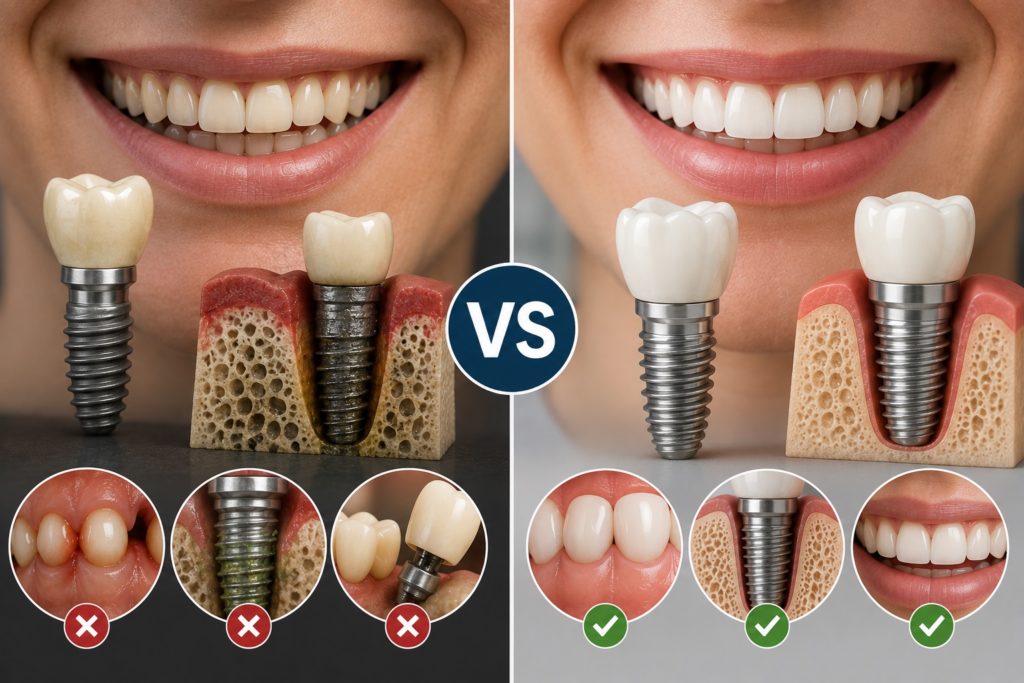
Cheap vs Premium Tooth Implants: A Side-by-Side Look
| Factor | Cheap Implants | Premium Implants |
| Titanium grade | Grade 2-3 or mixed alloys | Grade 4-5 medical-grade titanium |
| Purity level | 95-98% | 99%+ |
| Surface treatment | Basic or none | Advanced (SLA, anodised) |
| Clinical research | Limited or no long-term data | Decades of peer-reviewed studies |
| Success rate at 10+ years | Unknown | 95-98% |
| Diagnostic planning | Often skipped or minimal | Specialists with advanced training |
| Surgeon experience | Maybe less experienced | Specialists with advanced training |
| Warranty | Rare or limited | Comprehensive manufacturer warranty |
| Parts availability | May become unavailable | Global supply network |
| Hidden costs | Many | Few or none |
When Cheap Might Actually Work
There are situations where a lower tooth implant cost genuinely makes sense. They’re fairly specific, though.
Patients with good bone density, healthy gums, and no complicating factors might do fine with a budget implant, provided it’s from a reputable manufacturer. That word “reputable” is doing a lot of work in that sentence. Not every discount brand is bad; some still meet solid quality standards.
The trouble is most patients have no real way to judge implant quality themselves, and plenty of budget clinics aren’t upfront about which brand they use or what training their surgeon has.
If you’re weighing up a lower-cost option, these are worth asking outright:
- What brand of implant are you using?
- How long has that brand been on the market?
- What’s the success rate for that specific implant system?
- What training and experience does the surgeon have?
- What exactly is included in the quoted price?
- Is there a warranty, and what does it cover?
Vague or dodgy answers to any of these are a red flag worth taking seriously.
What You Are Really Paying For
Tooth implant cost was never really about the titanium screw on its own. It’s the whole system of care wrapped around it.
You’re paying for the years of training behind a surgeon placing that implant safely and accurately. You’re paying for the tech that maps your jaw in three dimensions and guides the placement. You’re paying for materials built to sit inside your body for decades without issue. And you’re paying for the peace of mind that comes from knowing there’s real research and a warranty standing behind it.
Choose premium, and you’re not just buying a tooth; you’re buying some confidence that it’ll still be doing its job in ten, twenty, thirty years.
Red Flags to Watch For
When you’re comparing tooth implant costs side by side, keep an eye out for:
- Prices that seem too good to be true, because they usually are, and the advertised number probably excludes half of what you’ll need
- Clinics that won’t tell you the implant brand, which usually means there’s a reason they’re avoiding the question
- No mention of CBCT scanning anywhere, since placing an implant without 3D imaging is a bit like driving with your eyes half closed
- Pressure to decide on the spot, because solid treatment doesn’t need a hard sell to get you across the line
- No follow-up care is built in, since your implant needs monitoring, and a clinic that disappears once it’s placed leaves you on your own
Look Beyond Today's Price Tag
Think about the last time you bought something cheap that did not last. Maybe it was a pair of shoes that fell apart in months. Or an appliance that stopped working right after the warranty expired. You ended up spending more to replace it than you would have if you had bought quality the first time.
Tooth implants work the same way. The only difference is that the stakes are much higher. This is not a pair of shoes. This is your health, your smile, and your quality of life. When you look at tooth implant cost through that lens, the decision becomes clearer. Invest in something that lasts.
Sydney Dental Implant Centre gives patients transparent tooth implant cost information with no hidden fees tacked on later. The team works with premium implant systems backed by decades of clinical data, and every patient gets proper diagnostics, experienced surgical care, and ongoing support after treatment.
If you’re weighing up your options and want a straight answer on what makes sense for your situation, get in touch to discuss your tooth implant options and get a clear picture of what quality care costs.
Frequently Asked Questions
1. What is the average tooth implant cost in Australia?
The average tooth implant cost in Australia ranges from $3,000 to $6,000 per tooth, including the implant, abutment, and crown. However, the final cost depends on factors like the complexity of your case, the materials used, and whether you need additional procedures such as bone grafting.
2. Why are some tooth implants so much cheaper than others?
Cheaper tooth implants often use lower-grade materials, less experienced providers and may exclude essential steps like CBCT scanning and digital planning from the quoted price. The advertised price usually covers only the titanium post, with everything else costing extra.
3. What are the risks of choosing cheap dental implants?
Risks include implant failure, infection, bone loss, and the need for corrective surgery. Cheap implants may use inferior materials that increase the risk of inflammation or rejection. If the implant fails, replacement costs often exceed what you would have paid for quality treatment from the start.
4. How long do premium tooth implants last compared to cheap ones?
Premium tooth implants from established manufacturers have documented success rates of 95 to 98 percent at ten years or more. Cheap implants often lack long-term clinical data, making their longevity uncertain. With proper care, premium implants can last twenty years or longer.
5. What should I look for when comparing tooth implant costs?
Look for transparency about what is included in the price. Ask about the implant brand, the surgeon’s experience, whether CBCT scanning is part of the treatment, and what warranty or follow-up care is provided. A comprehensive quote should include the implant, abutment, crown, scans, and surgical placement.
6. Does dental insurance cover tooth implant costs?
Most dental insurance plans cover only a portion of tooth implant costs. Coverage varies widely between policies. Some plans cover the crown but not the implant itself. It is important to check with your insurer before proceeding with treatment.
Authors Detail
Dr. Manish Shah
BDS, MBBS, MMED (Sleep Medicine)
Dr. Manish Shah is a dual-qualified dentist and medical doctor with over 15 years of experience in cosmetic, implant, and restorative dentistry. He holds a Master’s in Sleep Medicine and specialises in TMJ disorders, sleep apnea, and craniofacial pain. Dr. Manish Shah provides complete dental care at Sydney Dental Implant Centre.
