Table of Contents
If you have been researching dental implants, you may have come across the term robotic dental implant surgery. Some dental clinics highlight its ability to help dentists place implants with greater precision, while others continue to use traditional or computer-guided techniques.
So, what exactly is robotic dental implant surgery? Is it better than conventional implant treatment, and could it be the right choice for you?
In this guide, we explain how robotic assistance works, what current research suggests, who may benefit from it, and what to consider before choosing this treatment.
Please remember that every patient is different. This article provides general information and is not a substitute for advice from a qualified dentist or implant surgeon.
What Is Robotic Dental Implant Surgery?
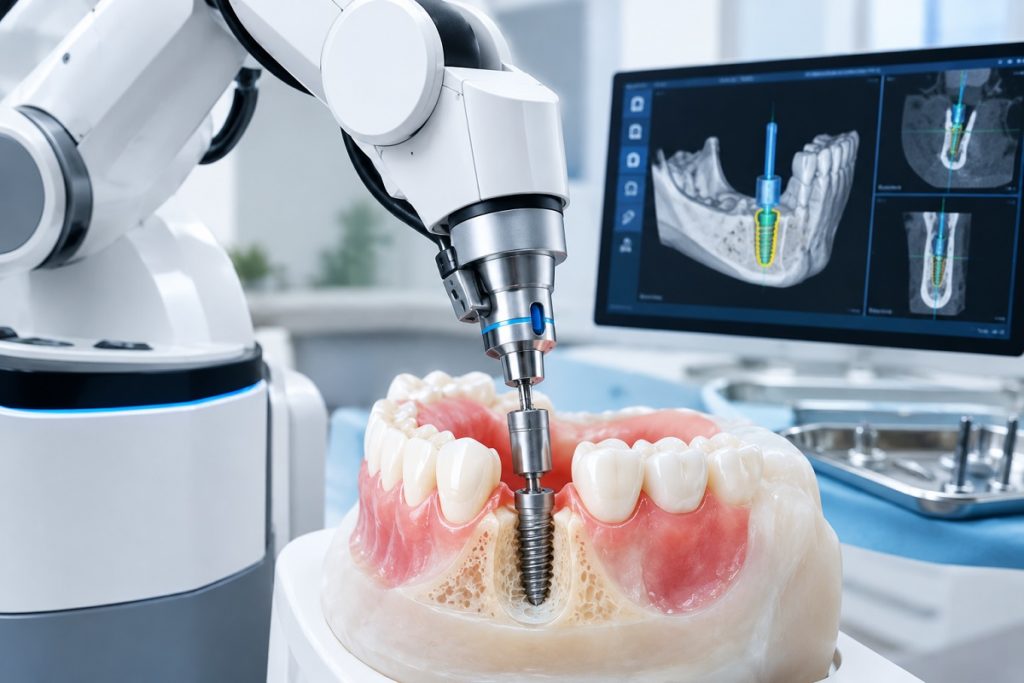
Robotic-assisted dental implant surgery combines modern technology with the expertise of a dentist surgeon to help place implants in their planned positions.
During implant placement, robotic technology helps the dentist follow the treatment plan with greater precision. Depending on the system, it may offer live visual feedback, guide the instrument’s movement, or alert the clinician when the drill moves away from the planned position.
It is important to remember that the technology does not work independently. The dentist or oral surgeon remains in control of the procedure, makes all important treatment decisions, and uses the system as a tool to support accurate implant placement.
How Does Robotic Dental Implant Surgery Work?
The steps in robotic dental implant surgery may differ depending on the technology available and the patient’s treatment needs.
1. Initial Dental Assessment and 3D Imaging
The process begins with a detailed dental examination. Your dentist checks the condition of your teeth to determine whether implant treatment is suitable.
A 3D scan, such as a cone beam CT (CBCT) scan, may be taken to assess bone volume and locate important structures, including nerves and sinuses. These images give the dental team a clearer understanding of your oral anatomy and help them plan the procedure.
2. Planning the Implant Position Digitally
Once the examination and scans are complete, your dentist uses specialised software to plan the implant placement. This includes deciding the appropriate position, angle and depth for each implant.
The plan takes into account the available bone, surrounding structures and the type of replacement tooth or dental bridge that will be attached later. per-planning helps support both the function and appearance of the final restoration.
3. Preparing the Robotic Guidance System
When surgery starts, the dental team sets up the robot and links it to your digital treatment plan.
Depending on the system, tracking sensors or reference markers may be used to monitor the position of your jaw during the procedure. This allows the technology to provide guidance based on the planned implant position.
4. Placing the Implant with Technological Assistance
At the time of surgery, the dentist uses the guidance system to help position the implant according to the digital plan. Some systems provide visual information, while others offer physical alerts if the drilling position moves away from the intended path.
The level of assistance varies between systems, but the clinician remains responsible for controlling the procedure and making treatment decisions.
5. Reviewing the Implant Placement
After the implant has been placed, the dentist checks its position and evaluates the surgical result. Additional scans or imaging may be used if needed to confirm the outcome.
The after stage depends on your individual treatment plan and healing progress. Some patients may receive temporary replacement teeth, while others need to allow time for the implant to integrate with the jawbone before the final crown or bridge is fitted.
What Are the Advantages of Robotic Dental Implant Surgery?
Robotic-assisted dental implant surgery can result depending on the patient’s oral health, the type of technology used and the dentist’s skill and experience.
Greater Control Over Implant Placement
Robotic guidance is designed to help dentists place implants according to a carefully prepared digital plan. This can be especially helpful when the implant’s position, angle and depth need to be controlled precisely.
Although the technology can support accurate placement, it cannot completely remove the risks associated with implant surgery.
Help with More Challenging Implant Cases
Some patients require more complex implant treatment because of limited jawbone, the location of nearby nerves of teeth.
In suitable cases, robotic guidance may help the dentist manage these challenges and follow the planned implant positions more closely.
Final Thoughts
Robotic dental implant surgery is a development in modern dentistry. By combining digital planning with guided implant placement, it may help clinicians achieve accurate positioning,
However, it is not a perfect solution, and it is not automatically better for everyone. Evidence about long-term benefits, faster recovery and improved implant survival is still developing. The technology’s availability and cost also vary between clinics.
Our team is here to help you understand your options. Book a consultation to discuss your dental needs, explore suitable implant treatments and receive a personalised treatment plan explained in clear, simple language.
Authors Detail
Dr. Kinnar Shah
BDS, Certified High Performance Coach
Dr. Kinnar Shah is a cosmetic dentist with a special interest in cometic dentistry, porcelain veneers and dental implants practising at Smile Concepts.