Table of Contents
One of the harder things to hear after losing teeth is, “You don’t have enough bone for dental implants.”
For a lot of people, that sounds like the final word. They figure the only options left are dentures or just living with the gaps. But implant dentistry has moved on a lot over the past couple of decades, and what wasn’t possible when you were first told this might genuinely be worth another look now.
Having bone loss doesn’t automatically mean you’re ruled out of all on four dental implants. The real question isn’t just how much bone you’ve got left. It’s where that bone still is, how healthy it is, and whether it can support a properly planned implant treatment.
Why "You Don't Have Enough Bone" Isn't Always the Full Story
Bone loss is genuinely just one part of the picture. Plenty of patients who were told years ago that they weren’t candidates for implants turn out to still be eligible for all on four dental implants, mainly because this treatment approaches bone in a different way than older methods did.
Years ago, replacing a full arch of missing teeth usually meant placing a lot of implants right across the jaw. If there wasn’t enough bone to go around, the answer was often extensive grafting before anything else could even start.
Things have moved on since then.
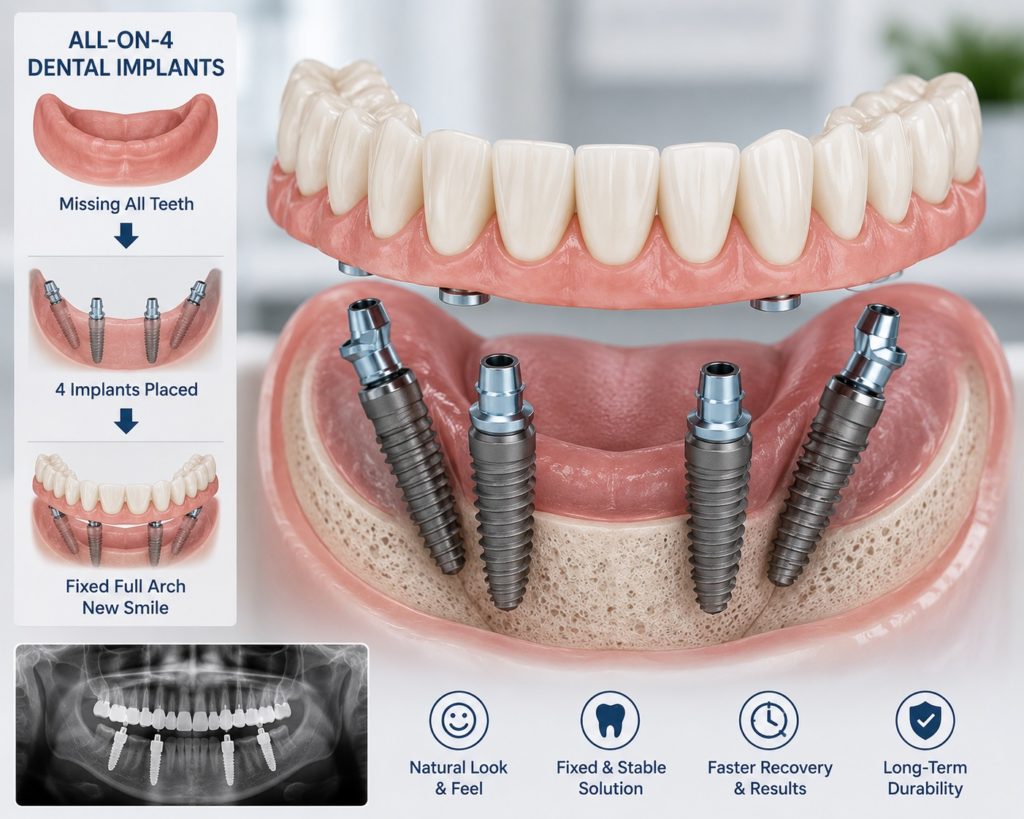
Instead of trying to put an implant under every missing tooth, all on four dental implants support a whole arch using just four implants, positioned carefully. That kind of planning lets a clinician work with the areas where bone is naturally stronger, even if other parts of the jaw have deteriorated over time.
Which is why two people can have very similar-looking X-rays and still walk away with quite different treatment recommendations. It comes down to their individual anatomy, not just a general impression of “how much bone is left.”
The Real Question Isn't "Do You Have Bone Loss?" It's "Where Has the Bone Been Lost?"
Where the bone is, and how dense and healthy it is, usually matters more than the total volume. Rather than a quick look and a guess, modern implant planning maps your jaw in three dimensions.
Bone doesn’t shrink evenly across the jaw.
Some areas can lose a lot of density fairly quickly once teeth are gone, while other parts hold up well and can support implants for years.
When you’re being assessed, your practitioner is generally looking at things like:
- how tall the remaining bone is
- how wide it is
- how dense it is
- where your sinuses sit
- where the important nerves run
- how your bite and jaw line up
| Assessment | Why It Matters |
| Bone density | Denser bone tends to give an implant better initial stability. |
| Bone height | Affects whether implants can go in safely without getting too close to other structures. |
| Bone width | Needs to be enough to properly support the implant. |
| Upper vs lower jaw | Bone quality is naturally a bit different between the two. |
| Front vs back of the jaw | Some areas hold onto stronger bone even after years without teeth. |
This is really the whole argument for a proper CBCT scan rather than just going off how long ago you lost your teeth.
Why All on Four Was Designed Differently
All on four dental implants were built around getting the most out of the bone that’s already there, using strategic implant placement rather than trying to fill every gap. For a lot of suitable patients, that means avoiding the kind of extensive grafting older approaches often needed.
The idea isn’t complicated, and it’s well established at this point.
Rather than placing implants straight up and down throughout the jaw, the back two implants are often angled into the stronger bone that’s usually still available in those areas. Done well, this can help steer clear of sensitive structures while improving how stable the implants end up being.
That’s part of why this approach can work well for people who’ve had a moderate amount of bone loss.
It doesn’t mean everyone with bone loss is automatically a candidate, to be clear. It just means the assessment is a lot more individual than a lot of people assume going in.
Patients Who Are Often Surprised They May Still Be Eligible
A surprising number of adults assume they’re no longer candidates because of their own dental history, when really their situation deserves a fresh look with today’s technology rather than an assumption based on an old conversation.
It might be worth booking another consultation if any of this sounds like you:
- you’ve worn full dentures for a long time
- several of your remaining teeth are failing from decay or fractures
- you lost teeth because of advanced gum disease
- you were last assessed before digital planning was really common
- you were told bone grafting was your only option
- your gums and jawbone have gradually been shrinking
None of these situations guarantees treatment is possible.
They don’t rule it out either.
Every case really is its own thing.
When Bone Grafting May Still Be Needed
A lot of patients getting all on 4 avoid extensive grafting altogether, but that’s not true for everyone. Some people with more advanced bone loss still need additional procedures before implants can go in safely.
Every Case Is Different
| In some suitable cases | In other cases |
| The existing bone is enough on its own. | Bone grafting may be recommended first. |
| Treatment can often go ahead without major augmentation. | Sinus augmentation might be needed in the upper jaw. |
| Implants can sometimes be placed sooner. | Some healing time may be required before implants go in. |
What you end up being recommended really comes down to your own anatomy, not a one-size-fits-all rule.
What Your CBCT Scan Actually Reveals
A CBCT scan gives a proper three-dimensional view of your jaw, which lets implants be planned digitally before anything’s done. It shows a lot more than a standard dental X-ray ever could.
During your consultation, that scan helps your practitioner look at things like how much bone volume you’ve got left, its density, the shape of your jaw, where your sinuses and nerves sit, any areas affected by past infection, where implants could realistically go, and how your bite lines up.
With that level of digital planning, your dental practitioner can work out fairly precisely whether all on four dental implants make sense for you before treatment even begins.
Does Bone Loss Affect the All on Four Cost?
Bone loss can play into the all on four cost, but it’s just one piece of a bigger picture, not the whole story.
Your final estimate usually comes down to a few things: whether any remaining teeth need to come out, whether bone grafting or other prep work is needed, how complex the implant placement itself is, which type of final bridge you choose, how many review appointments are built in, and what ongoing maintenance looks like.
Because of all that, it’s honestly rare that anyone can give you an accurate figure without a proper clinical exam and a 3D assessment first.
Depending on your level of cover, some private health funds may also put money toward treatment, and a lot of practices offer flexible payment plans on top of that.
Five Signs It's Worth Getting Another Implant Opinion
Implant techniques keep improving, so if your last assessment was a while ago, what’s on the table for you now could look quite different.
It’s probably worth booking another consultation if:
✔ your last assessment was more than five years ago
✔ that assessment didn’t include a CBCT scan
✔ you were told dentures were your only option
✔ you were told bone loss ruled implants out entirely
✔ you’re getting more and more fed up with loose dentures or teeth that keep failing
Sometimes a second look confirms the original answer.
Sometimes it doesn’t.
Either way, a modern assessment gives you clarity based on what’s possible now, not what wasn’t possible years ago.
Being told you have bone loss doesn’t have to mean the door on implants is shut for good. A lot of patients who assumed they had no options find out that all on four dental implants are still on the table, because the planning is really about the quality and location of the bone you’ve got left, not just the total amount.
The important first step is getting an accurate picture of where things stand. A proper consultation, backed by digital imaging, is what lets your dental practitioner tell you honestly whether treatment fits your situation, along with the benefits, limitations, risks, and what you can realistically expect.
About Sydney Dental Implant Centre
Sydney Dental Implant Centre specialises in implant dentistry, treating patients with needs ranging from straightforward implant cases to more complex restorative treatments. Using advanced CBCT imaging, digital treatment planning, and care built around the individual, the team looks closely at each case to work out what actually makes sense, rather than applying the same plan to everyone who walks through the door.
If you’ve been told before that you don’t have enough bone for implants, it might be worth getting a fresh, up-to-date assessment. Book a consultation to talk through your options properly.
Frequently Asked Questions
1. Can I get all on four dental implants if I've been told I have severe bone loss?
Possibly, yes. Bone loss on its own doesn’t decide your suitability. A lot of people with reduced jawbone are still suitable for all on four dental implants, depending on where healthy bone remains. You’ll need a proper examination and CBCT scan before anyone can tell you for sure.
2. Is all on 4 designed for people with reduced bone?
Part of why all on 4 has become so widely used is that it lets implants be positioned in the areas where stronger bone tends to hang around, even after a lot of loss elsewhere. That can cut down on the need for extensive grafting in suitable cases, though it won’t suit absolutely everyone.
3. Does severe bone loss always increase the all on four cost?
Not always. The all on four cost depends on your overall treatment needs. Things like bone grafting or extractions can add to the cost, but every plan is built around the individual rather than a fixed price list.
4. Can wearing dentures for many years cause bone loss?
Yes, it can. Once teeth are gone, the jawbone stops getting the stimulation it normally gets from chewing, and it can gradually shrink over time as a result. It’s a pretty common reason long-term denture wearers end up looking into implants.
5. How do dentists know whether I still have enough bone?
Mainly through a CBCT scan, which gives a three-dimensional view of your bone, the surrounding anatomy, and where implants could potentially go. That’s what practitioners rely on, rather than a visual estimate.
6. Are all on four dental implants suitable for everyone?
No, not everyone. All on four dental implants open up options for a lot of people who’ve had bone loss, but like any surgical procedure, it carries risks, and not everyone will be a good candidate. A proper assessment is the only way to know what’s safest and most appropriate for you.
Disclaimer: Any surgical or invasive procedure carries risks. Before proceeding, you should seek a second opinion from an appropriately qualified health practitioner.
Authors Detail
Dr. Manish Shah
BDS, MBBS, MMED (Sleep Medicine)
Dr. Manish Shah is a dual-qualified dentist and medical doctor with over 15 years of experience in cosmetic, implant, and restorative dentistry. He holds a Master’s in Sleep Medicine and specialises in TMJ disorders, sleep apnea, and craniofacial pain. Dr. Manish Shah provides complete dental care at Sydney Dental Implant Centre.
