Table of Contents
When a tooth goes missing, something in your mouth just never feels quite right again. The biggest question almost everyone asks is: which replacement will actually feel like a real tooth in your day-to-day life? You will find two names coming up again and again. Dental implants and denture implants. Both have the same goal. A complete smile. But one feels significantly more natural inside your mouth.
Let us break this down in simple words so you can decide with confidence.
Understanding the Difference Between Dental Implants and Denture Implants
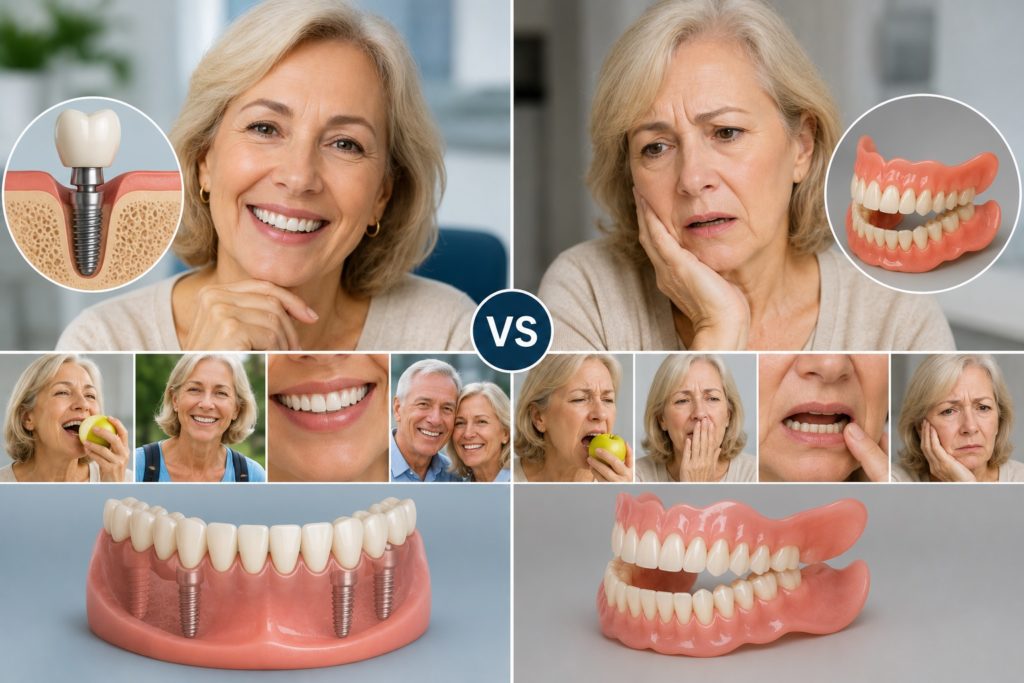
Old school dentures are removable. They sit right on top of your gums and replace multiple missing teeth. You take them out at night to clean them.
Dental implants are small titanium posts that go right into your jawbone. After everything heals, they hold replacement teeth that stay put. Depending on how many teeth you are missing, implants can hold single crowns, bridges, or a whole arch of teeth.
For people who want extra stability without going all in on individual implants, denture implants are a great middle ground. Instead of just resting on your gums, the denture snaps onto implants placed in your jaw. Solid during the day. Removable at night.
Quick Comparison: Dental Implants vs Dentures
| Feature | Dental Implants | Traditional Dentures |
| Stability | Fixed and secure | Shifts when you eat or talk |
| Bone Preservation | Keeps your jawbone strong | Does nothing to stop bone loss |
| Cleaning | Take them out every night. Soak them. Special brushes. | Brush and floss like normal teeth. |
| Bone Preservation | Keeps your jawbone strong | Does nothing to stop bone loss |
| Eating Ability | Almost like natural teeth | You will avoid some foods |
| Speech | Barely any change | Takes time to get used to |
| Maintenance | Brush and floss like normal teeth | Take them out to clean |
| Longevity | Can last decades with good care | Need replacing every few years |
| Comfort | Feels much more natural | Can rub and cause sore spots |
| Cost | More money upfront | Cheaper to start with |
How Dental Implants Feel Compared to Dentures
When people ask whether teeth implants feel natural, they are really asking about everyday stuff. Chewing. Talking. Laughing out loud. Smiling without thinking about it.
This is where implants shine.
Because teeth implants are anchored right into your jawbone, they work just like your natural tooth roots used to. Once everything heals, most people say they completely forget they even have implants. They just become part of your normal day.
Denture implants work fine, but you are always aware of them. Some people need adhesives. Some need adjustments. And as your gums change shape over time, your dentures start fitting worse.
Which Option Gives You Better Chewing Power?
Mealtime is where you really notice the difference.
With regular dentures, hard or chewy foods get tricky. Some foods make your denture implants move around. Others cause pain, especially if your dentures do not fit perfectly anymore.
With dental implants, your biting force goes right through the implant into your jawbone. That means you can eat almost anything you want.
Food Type | Dental Implants | Dentures |
| Steak | No problem | Way more stable. You can eat most things. |
| Apples | Bite right in | Have to cut them up |
| Nuts | Generally fine | Most people avoid them |
| Crusty Bread | Easy | Can shift your dentures |
| Salads & Vegetables | Easy | Takes some getting used to |
The Long-Term Impact on Your Jawbone
Here is something most people do not think about when comparing options. What goes on underneath your gums matters just as much as what you see.
When you lose a tooth, your jawbone stops getting the stimulation it normally gets from that tooth root. Over time, the bone slowly shrinks.
Regular dentures sit on top of your gums and do nothing to stop this. As your bone shrinks, your dentures get looser and looser. You need adjustments. You need relines. It never ends.
Dental implants stimulate your jawbone just like natural roots do. That keeps your bones from shrinking and helps maintain your facial shape. This is why so many people feel implants are more natural years after treatment, not just right after surgery.
If you are missing multiple teeth, denture implants can also help slow down bone loss while giving you way better denture stability.
How Teeth Implants Affect Speech and Confidence
The first thing many people notice after losing teeth is how their speech changes.
Dentures take time to get used to because you have this plastic appliance sitting against your gums and the roof of your mouth. You might slur some words or whistle on S sounds for a while.
Implants barely affect your speech because your replacement teeth are fixed in place and do not move around.
People often say they feel way more confident with implants during:
- Work meetings
- Family dinners
- Giving a speech
- Eating out with friends
- Weddings and parties
Just knowing your teeth will not shift or click unexpectedly makes a huge difference.
Comparing Long-Term Care Requirements
Many people think dentures are easier because you do not need surgery. But in the long term, the maintenance story flips around.
Traditional Dentures
- Take them out every night to clean
- Soak them overnight in the solution
- Need periodic adjustments
- Gums change shape, so you need relines
- Replace them every 5 to 10 years
Dental Implants
- Brush them like normal teeth
- See your dentist for checkups
- Get professional cleanings
- Never take them out
For most people, the simplicity of caring for fixed teeth implants ends up being a huge win.
When Denture Implants Are the Right Choice
If you want more stability but cannot replace every missing tooth with a single implant, denture implants are a solid middle ground.
Instead of relying on suction or sticky adhesives, an implant supported denture snaps onto implants placed in your jaw.
What you get with denture implants:
- Better chewing power
- No more denture movement
- More comfort overall
- Clearer speech
- Stays put while you eat
Let Us Talk About Cost
Cost always matters when you are comparing treatments.
Traditional dentures cost less upfront. But you also need to think about ongoing maintenance, relines, repairs, and, eventually, full replacements.
Dental implants cost more to start with, but they last a very long time. For many people, that upfront investment pays off over the years.
Your exact cost depends on a few things:
- How many teeth are missing
- How much bone do you have left
- How many implants do you need
- Whether you need extra procedures like bone grafting
- What kind of restoration will you choose
Are You a Good Candidate for Dental Implants?
You might be surprised to learn that many adults might qualify for implants even if they have been missing teeth for years.
You could be a good fit for implants if:
- You have one or more missing teeth
- You are generally healthy
- You have enough bone, or you are open to bone grafting
- You want a fixed replacement that never comes out
- You are looking for a long-term solution
A proper exam will tell you for sure which treatment works best for your situation.
Which Tooth Replacement Option Comes Closest to Natural Teeth?
If all you need is something to fill the gap, both denture implants and dental implants get the job done.
But if you care about comfort, stability, chewing your favourite foods, speaking clearly, and feeling confident for years to come, dental implants come the closest to your natural teeth.
For people who want better denture stability without going all the way to individual implants, denture implants offer a smart investment that works well for many patients.
The right choice depends on your mouth, your goals, your lifestyle, and your budget. But knowing how each option feels on a normal Tuesday makes the decision a whole lot easier.
About Sydney Dental Implant Centre
Sydney Dental Implant Centre focuses only on implant dentistry and full mouth rehabilitation. The team creates individual treatment plans for patients with single missing teeth, multiple missing teeth, or advanced tooth loss. We use modern tools and honest advice to help patients find the right implant solution for their needs.
Whether you are thinking about traditional dentures, denture implants, or full dental implants, understanding your options is the first step toward getting your comfort and confidence back.
Book a consultation to talk about your goals, get your mouth assessed, and find out which solution will feel most natural for your life and your budget.
Frequently Asked Questions
1. Do dental implants feel like real teeth?
Yes. Once healed, dental implants work almost exactly like natural teeth. Most patients eat, talk, and smile without noticing any real difference.
2. Are denture implants better than traditional dentures?
For many people, yes. Denture implants give you better stability, stronger chewing, and more comfort because they snap onto implants instead of just sitting on your gums.
3. How long do teeth implants last?
With regular brushing and checkups, teeth implants can last many years. Often decades. The crown on top may need replacement after 10 to 15 years, but the implant post stays.
4. Can I eat normally with dental implants?
In most cases, yes. After you heal, you can eat almost anything you want, such as a steak, apples, nuts, and crusty bread. No more cutting everything into tiny bites.
5. Are dental implants worth the higher cost?
Most people who get implants say yes. Better comfort. Better stability. Your bone stays strong. And they last so long that the upfront cost makes sense over time.
6. Can dentures become loose over time?
Yes. As your jawbone changes and shrinks after tooth loss, your dentures will fit worse and worse. You will need adjustments, relines, or eventually a whole new set.
Authors Detail
Dr. Kinnar Shah
BDS, Certified High Performance Coach
Dr. Kinnar Shah is a cosmetic dentist with a special interest in cometic dentistry, porcelain veneers and dental implants practising at Smile Concepts.